

And why timing matters more than you think
APFS is the foundation of modern macOS systems, yet one of the most important facts about it is often overlooked. Apple has never published a complete, authoritative specification for APFS.
There is documentation available. Apple has released developer materials, conference sessions, and high-level technical overviews. But there is no single, comprehensive specification that defines every structure, behavior, and edge case of the filesystem. For everyday users, that distinction does not matter. For forensic examiners, it matters more than most people realize.
How APFS Knowledge Is Built Today
What the forensic community understands about APFS today is largely built from observation, testing, and reverse engineering. Over time, this has produced capable tools and impressive results. However, it also means that much of the interpretation happening outside of macOS itself is based on inference rather than complete certainty.
In practice, that means many tools are making educated assumptions about how APFS works. In many cases those assumptions are accurate. In some cases, they are incomplete. And in others, they may be wrong without the examiner even realizing it. This is where the problem becomes more than technical. It becomes evidentiary.
The Ongoing Challenge of Reverse Engineering
Reverse engineering a filesystem is not a one-time effort. It is a continuous process that must keep pace with changes introduced by the operating system. APFS is actively maintained and evolves with macOS. Structures change, behaviors shift, and new relationships are introduced over time. When tools rely on reverse engineered knowledge, there is always a gap between what macOS is doing and what the tool understands.

That gap can show up in subtle ways. A parser may process a volume without errors and still miss important fields. Metadata may appear complete but lack critical relationships. Timestamps may be interpreted in a way that looks correct but does not fully reflect how the system recorded them. These are not obvious failures. They do not generate warnings. They often look like valid results, which is what makes them so dangerous in an investigation.
Reading APFS vs Understanding APFS
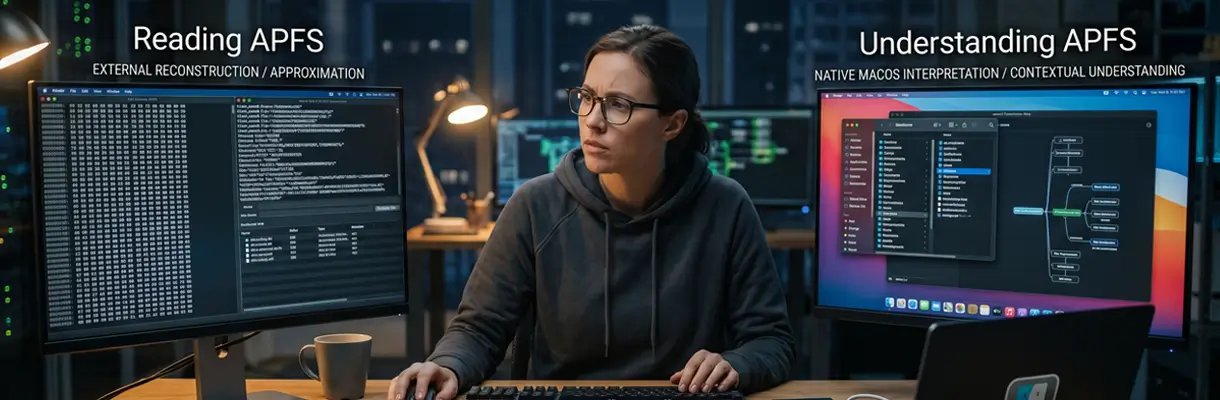
There is also a growing difference between being able to read APFS and being able to understand it as macOS does. Extracting data is not the same as interpreting it within the context of the operating system. APFS is tightly integrated with macOS, and its behavior is influenced by system frameworks and internal logic that are not fully exposed through public documentation.
When tools attempt to reconstruct that logic externally, they are approximating how the system works. Sometimes that approximation is close enough. Sometimes it is not. The challenge is that the examiner may not know which scenario they are dealing with.
This is where a native approach offers a different path.
Instead of attempting to fully reverse engineer APFS, a native solution leverages macOS itself to interpret its own filesystem. The same operating system that created the data is used to help understand it. Structures are read in the way macOS expects them to be read. Metadata is interpreted using native frameworks. Relationships between files, snapshots, and system components are preserved in their original context.
Why Native Tools Improve Accuracy
Using a tool such as RECON LAB, the examiner is not relying solely on reconstructed knowledge of APFS. The analysis is grounded in how the operating system actually behaves, not how it is believed to behave based on external interpretation.
This becomes more important with every macOS update. As Apple continues to evolve APFS, tools that operate outside the system must constantly adapt to keep up. There will always be a delay between change and full understanding. Native approaches, by contrast, remain aligned with those changes because they operate within the environment where those changes occur.
For forensic examiners, the question is not whether a tool can access APFS data. The real question is whether that data is being interpreted in a way that accurately reflects how macOS stored and managed it.
APFS is one of the most advanced filesystems in use today, but it is also one of the least fully documented. That combination makes it powerful, but it also makes it challenging to analyze from the outside. Reverse engineering has taken the forensic community a long way, and it will continue to play an important role. But it will always have limitations when the full specification is not available.
At the end of the day, the difference comes down to confidence. Are you working from a reconstruction of how APFS should work, or are you working from how it actually does? In forensic work, that difference matters.
Message Us to See It in Action