

Architectural shifts and the future of macOS examinations
The release of the MacBook Neo is a watershed moment for digital forensics. While the headline focuses on the $599 price point and its entry into the budget market, the technical reality is far more complex. This system represents the most significant convergence of iOS and macOS hardware to date. For the forensic examiner, the MacBook Neo is not just a more affordable computer; it is a shift in how data is secured, stored, and accessed.
With early sales exceeding the 5 to 6 million units initially projected by Apple, the “Neo” is rapidly becoming a staple in education and consumer markets. Consequently, it will soon become a frequent encounter in criminal and corporate investigations.
The Evolution of Integrity
The defining technical characteristic of the MacBook Neo is the A18 Pro System on a Chip (SoC). This marks a departure from the M-series chips typically found in Apple desktops and laptops. The A18 Pro is a mobile-class processor, sharing its lineage with the iPhone 16 Pro series.
This architectural shift has profound forensic implications:
SoC Composition: The A18 Pro utilizes a 6-core CPU (comprising performance and efficiency cores) alongside a 5-core GPU. While the core count may seem lower than high-end M-series chips, the Neural Engine and Media Engine remain highly optimized for mobile-first tasks.
The Secure Enclave (SEP): Because the A18 Pro is a mobile-class chip, the integration of the Secure Enclave is tighter than ever. The SEP manages the cryptographic keys for the entire system, including FileVault and user-level data protection.
Hardware-Backed Security: The boot chain of the A18 Pro follows the Mobile Secure Boot model. Every stage of the boot process is verified by hardware-rooted certificates. For the examiner, this means any attempt to bypass the OS via unauthorized bootloaders or external media is virtually impossible without proper credentials.
Storage, Encryption, and Data Access Logic
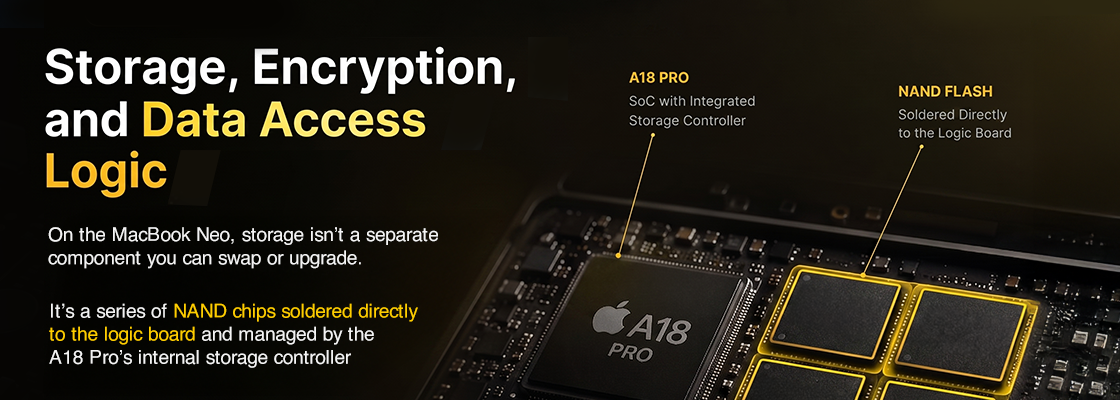
On the MacBook Neo, storage is not a separate component; it is a series of NAND chips soldered directly to the logic board and managed by the A18 Pro’s internal storage controller.
Full Disk Encryption (FDE): Like all Apple Silicon systems, the storage is encrypted at the hardware level. The encryption keys are tied to the specific A18 Pro SoC. Desoldering the NAND chips for “chip-off” forensics is a futile exercise, as the data remains mathematically inaccessible without the original processor and its UID/GID keys.
System State Dependency: Accessing meaningful data requires the system to be in an Authorized State. This means the examiner must work within the parameters of the operating system’s security model. Traditional bit-stream imaging of a “dead” disk will only yield an encrypted blob.
APFS and Snapshots: The MacBook Neo utilizes the Apple File System (APFS), which relies heavily on copy-on-write metadata. On a mobile-class chip like the A18 Pro, the way the system manages these structures (and specifically how it handles local snapshots during software updates) is critical for recovering deleted evidence.
Hardware Constraints and Power Management in the Field
The physical design of the MacBook Neo introduces immediate logistical challenges during a forensic encounter. The device is simplified, typically featuring only two USB-C ports.
Power Pass-Through Requirements: Given the limited port count, examiners must utilize hubs that support high-wattage power pass-through. If one port is occupied by a bootable imager or an evidence drive, the other must be capable of delivering sustained power to the host machine to prevent a shutdown mid-acquisition.
Bootable Imager Power Draw: Field kits must account for the power requirements of the bootable imaging environment and the attached evidence storage. If the hub or the power source is insufficient, the MacBook Neo may throttle the A18 Pro processor or intermittently drop the connection to external storage, leading to data corruption or failed imaging sessions.
Workflow Efficiency: These physical constraints demand a streamlined workflow. Practitioners must rely on software solutions that can maximize data throughput over a single bus while maintaining system stability under the power constraints of a mobile-class architecture.
The Standard of Truly Mac-Native Imaging
As Apple continues to blend mobile and desktop architectures, the ability of a forensic tool to operate natively within the Apple ecosystem is no longer optional. While most practitioners understand that a Mac-based imager is required, the differentiator is how quickly and effectively that tool adapts to new hardware releases.
A truly native forensic approach leverages the system’s own design to ensure a complete and defensible collection from the moment a new device is released.
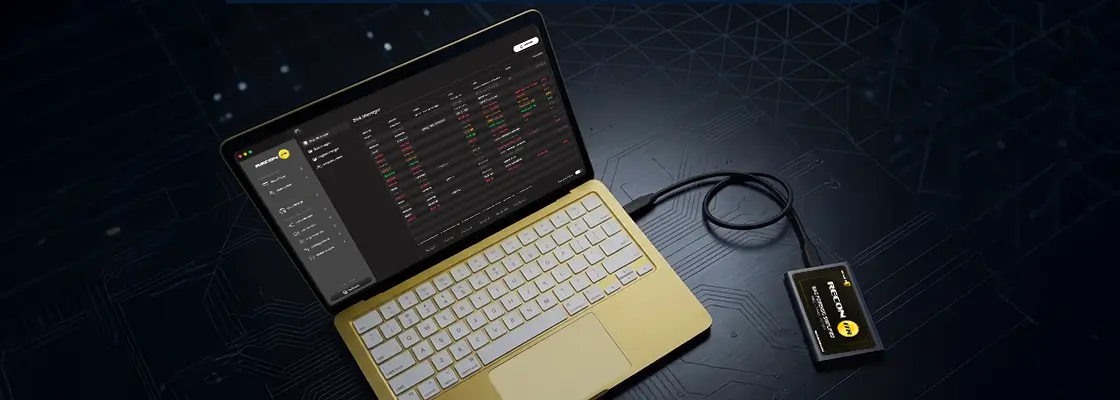
RECON ITR: Day One Support: While other Mac-based solutions often require weeks or months to validate support for new hardware classes, RECON ITR was engineered to support the MacBook Neo from day one. This level of readiness is a result of a “native-first” philosophy that aligns with Apple’s own hardware frameworks.
Environmental Adaptability: Whether in a live state or a bootable recovery environment, RECON ITR communicates directly with the system’s storage controller and security frameworks. This ensures that extended attributes, APFS snapshots, and system-level metadata are captured exactly as they exist on the target hardware.
Defensible Results: Native solutions ensure that the acquisition process adheres to Apple’s own filesystem logic. This is critical when presenting evidence from a high-security, hardware-encrypted device like the Neo, where the validity of the capture depends on the tool’s ability to respect the A18 Pro’s security protocols.
Final Forensic Outlook
The MacBook Neo is a harbinger of the next decade of digital forensics. Its low cost ensures it will be the most common Mac on the market, while its A18 Pro architecture ensures it will be one of the most difficult to examine for those without a native, updated workflow.
Examiners cannot afford to wait for their tools to catch up with the hardware in their hands. The MacBook Neo requires a specialized understanding of mobile-class security and a toolkit that respects the native design of the hardware. The “day one” readiness of RECON ITR ensures that your evidence collection is complete, defensible, and aligned with the current state of Apple technology.
The MacBook Neo is here, and it is the new standard. Your forensic approach must evolve accordingly.