

The critical gap between xattrs and Spotlight
In the world of macOS forensics, metadata is rarely a single source of truth. Instead, it is a layered ecosystem of file-level data and system-level indexes, each created for a different purpose and operating under different conditions. Relying on only one of these sources can introduce gaps that are not immediately obvious, but can significantly impact the outcome of an investigation.
Understanding the relationship between Extended Attributes (xattrs) and the Spotlight database is essential for conducting a complete and defensible examination.
1. Extended Attributes: The Filesystem Reality
Extended attributes are the most direct and reliable form of metadata available on macOS. They are stored as key-value pairs at the filesystem level and are written as part of normal operating system and application behavior.
Unlike indexed or derived metadata, xattrs exist with the file itself. They are not dependent on a service, cache, or database to be interpreted later. This makes them one of the most important sources of truth during an investigation.
Two of the most relevant examples include:
The Quarantine Attribute : The com.apple.quarantine attribute is applied to files that originate from external sources such as web downloads, email attachments, or AirDrop transfers. It can include details about the application responsible for the download, the timestamp, and flags that influence how macOS security features like Gatekeeper treat the file.
The WhereFroms Attribute : The com.apple.metadata:kMDItemWhereFroms attribute often complements quarantine data by storing the originating URL or source location of a file. In many cases, this can directly link a file to a specific download event.
2. Spotlight: The Metadata Server Index
Spotlight serves a different purpose. It is a system-level indexing and search framework designed to make data quickly accessible to the user.
It relies on background processes to monitor filesystem activity and build a searchable database of selected metadata. This makes it extremely useful for correlation and discovery, but it also introduces important limitations from a forensic perspective.
Indexing Lag: The com.apple.quarantine There is often a delay between file activity and when that activity is reflected in the index. Files that are short-lived or quickly deleted may never appear.
Service Dependency: Access to indexed metadata depends on system services that may or may not be available depending on how the system is being examined.
Selective Coverage: Spotlight does not index all metadata. It was built for usability, not completeness, which means certain attributes may never be included. Because of this, Spotlight should be treated as a valuable reference, but not as a complete dataset.
3. The Reality of Desynchronization
Extended attributes and Spotlight are not guaranteed to align, and in many cases they will not. A file may contain metadata that was never indexed. A file may be removed before indexing occurs. The index itself may be incomplete, outdated, or unavailable depending on system conditions.
This creates a situation where two legitimate sources of metadata can present different perspectives of the same event. Without understanding this relationship, an examiner may unknowingly rely on an incomplete view of the data.
4. The Examiner’s Choice: Live vs. Bootable
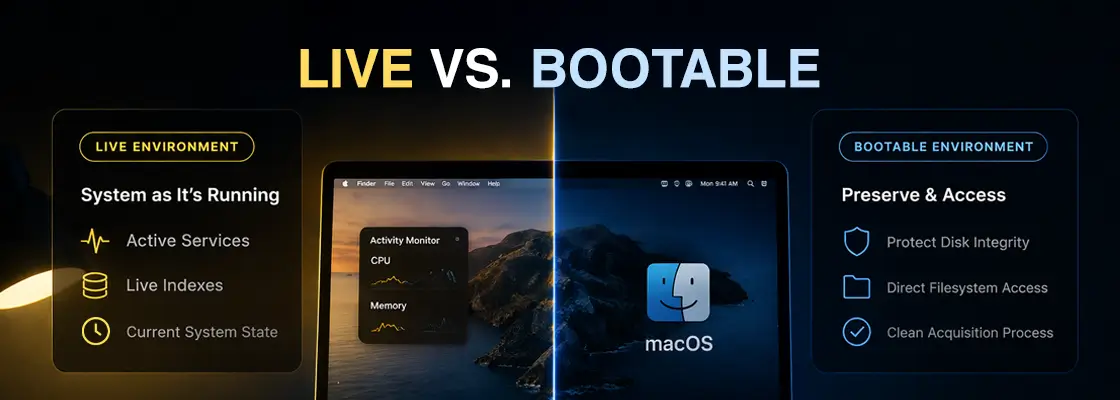
A key decision in macOS forensics is how the system is acquired. Each approach provides access to different aspects of metadata.
Bootable Environment
Booting into an external or controlled environment helps preserve disk integrity and allows direct access to filesystem structures. This is often the preferred approach for maintaining a clean acquisition process.
However, this environment is not identical to a fully running macOS system. Some system-level services and frameworks that exist during normal operation are not active in the same way.
Live Environment
A live acquisition allows interaction with the system as it is running. This includes access to active services, indexes, and system state as experienced by the user.
This can provide additional context, but it also introduces considerations related to system changes during acquisition. Each method provides value, but neither alone guarantees a complete picture.
5. Where Non-Native Approaches Break Down
Many forensic workflows still rely on post-processing methods such as parsing databases or running scripts against collected data.
This approach can lead to gaps when:
Extended attributes are not preserved during acquisition
Indexed data is incomplete or unavailable
Scripts do not reflect current macOS behavior
Relationships between artifacts are lost
macOS is constantly evolving. Approaches that rely on static interpretations of its data structures often fall behind.
6. Bridging the Gap: A Native Approach
The most effective strategy is to use a solution that can operate natively across different acquisition scenarios and adapt to the conditions of the system being examined.
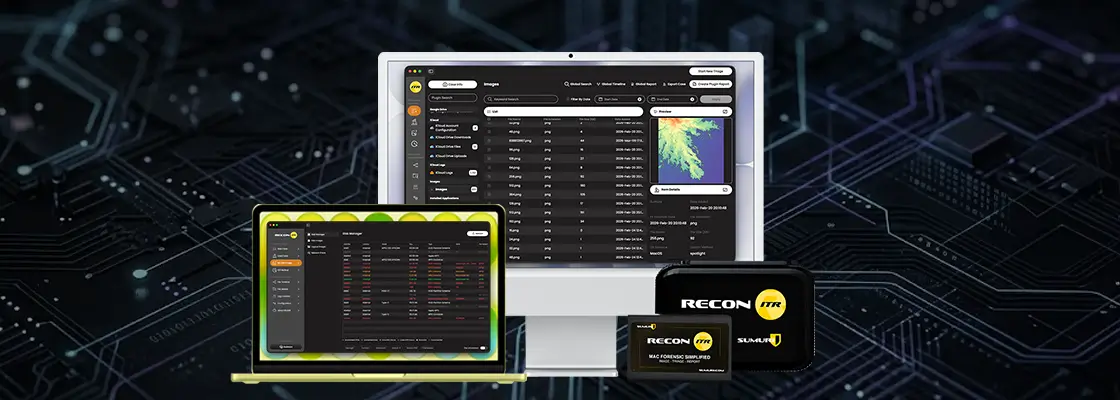
RECON ITR is designed with this flexibility in mind. Instead of forcing a single method, it provides multiple native approaches that allow the examiner to capture the most complete dataset possible based on the situation.
In Bootable Mode: The focus is on direct acquisition of filesystem structures, including extended attributes and metadata stores. Even in a limited environment, the underlying data is preserved so it can be analyzed in full context later.
In Live Mode: The system’s active state can be leveraged to collect indexed data alongside filesystem-level metadata. This provides additional visibility into how the system was operating at the time of acquisition.
Multiple Native Paths, One Goal: By supporting both approaches natively, the examiner is not forced into a tradeoff between integrity and visibility. Instead, they can choose the method that best fits the case while still ensuring that critical metadata is captured.

Conclusion
macOS metadata is not a single source. It is a combination of direct filesystem attributes and derived indexing systems, each with its own role and limitations. Extended attributes provide the most complete and persistent record of file activity. Spotlight provides a searchable but partial view designed for convenience.
Understanding how and when these sources diverge is essential for accurate analysis. The goal is not to choose one over the other, but to ensure that both are captured and interpreted in a way that reflects how macOS actually operates. When that approach is taken, the result is a more complete, more accurate, and more defensible forensic examination. The question remains the same. Are you seeing the whole picture, or just the index?
Are you seeing the whole picture, or just the index?
Talk to a Forensic Expert